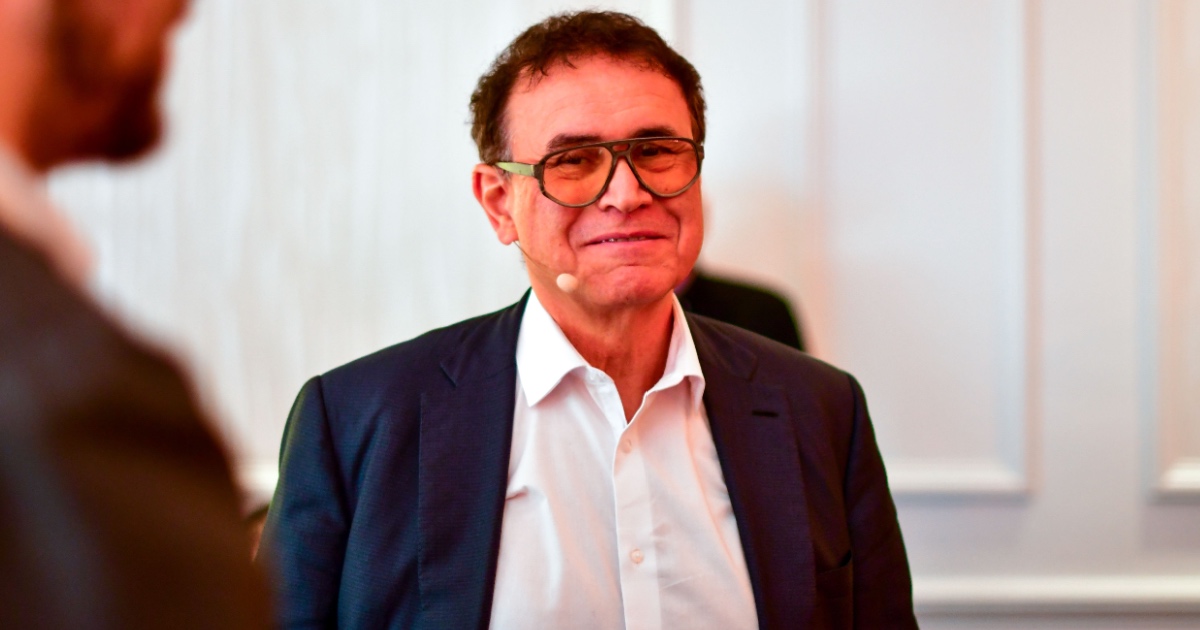

Nouriel Roubini, a Professor Emeritus of Economics at New York University’s Stern School of Business and CEO of Roubini Macro Associates, has spent decades telling audiences what they don’t want to hear. In the mid-2000s, when US housing prices were still climbing and Wall Street was still celebrating, he walked into an International Monetary Fund meeting in 2006 and delivered a forecast that most economists in the room laughed off. He said the US housing market was about to collapse, triggering a banking crisis and a deep global recession. Two years later, that is exactly what happened.
The man now known on Wall Street as “Dr. Doom” has followed up that economic crisis prediction with a series of increasingly stark warnings. He predicted in 2020 that the COVID-19 recession would surpass the 2008 financial crisis in severity. He has flagged secular stagflation, the end of the era of low inflation, and a coming scramble in bond markets. And in the summer of 2026, he is sounding new alarms, with consumer prices and Treasury yields as his primary concern.
For nearly two decades, Roubini has worn the nickname “Dr. Doom” with a certain pride. He earned it in the mid-2000s for warning of a housing crash that Wall Street dismissed – until he was proven catastrophically right. His record since then is what gives his current warnings their weight, and what his critics believe defines their limits.
The 2008 Warning That Made His Name
Roubini was one of the people who predicted the 2008 subprime mortgage crisis and the ensuing Great Recession. His 2006 housing call set the foundation for everything that followed. He warned well in advance that American consumers and financial institutions were carrying more risk than the system could absorb.
What came next justified those concerns. The 2008 financial crisis originated in the severe contraction of liquidity in global financial markets, rooted in the US housing collapse and the subprime mortgage crisis. Mortgage-backed securities – bundles of home loans sold to investors – sat at the center of the disaster. As the value of mortgage-backed securities held by investment banks declined in 2007 and 2008, several banks collapsed or were forced into emergency rescues. On September 15, 2008, Lehman Brothers sought Chapter 11 bankruptcy protection, becoming the largest victim of the subprime mortgage crisis that would devastate financial markets and contribute to the biggest economic downturn since the Great Depression. At the time of its collapse, Lehman Brothers was the country’s fourth-largest investment bank, with some 25,000 employees worldwide. The firm declared $639 billion in assets and $613 billion in debts, making it the largest bankruptcy filing in US history. The bankruptcy triggered a 4.5% one-day drop in the Dow Jones Industrial Average, then the largest decline since the attacks of September 11, 2001.
The economic toll was enormous. The crisis cost nearly nine million jobs, sent 12 million homeowners into foreclosure, and erased an estimated $10 to $15 trillion in global GDP. American families felt it for years. From 2008 through 2013, nearly 500 banks failed in the US – including Washington Mutual, the largest bank failure in FDIC history – at a total cost to the Deposit Insurance Fund of approximately $69 billion.
Roubini had seen it coming before almost anyone else with a platform was willing to say so publicly.
How He Called COVID Before It Was a Crisis
Roubini also warned that the COVID-19 recession could be even worse than 2008. When the pandemic began disrupting global supply chains and shutting down economies in early 2020, many analysts hoped for a quick V-shaped recovery. Roubini pushed back hard against that optimism.
The scale of what COVID-19 actually caused confirmed the grim logic of his economic crisis prediction. By early January 2025, over 777 million confirmed COVID-19 cases and more than 7 million deaths had been reported globally. When accounting for likely under-reporting and excess mortality – the difference between how many people died and how many would normally have been expected to die in those years – the true toll was far higher. The economic disruption matched the human one: supply chains fractured, labour markets twisted, and governments printed money at a scale not seen since World War II, flooding economies with debt that would fuel inflationary pressure for years.
Roubini argued throughout 2020 and beyond that the post-pandemic financial system would face a reckoning. Rising debt, deglobalization, and structural supply constraints would prevent central banks from cutting interest rates back to near-zero the way they had in 2009. He called this the transition to “secular stagflation” – a prolonged period where growth stalls while prices keep rising, a combination that central banks have almost no good tools to fight simultaneously. For a deeper look at how geopolitical events are already feeding into stagflation risks in 2026, the current oil supply disruption offers a useful parallel.
Three Scenarios for His Economic Crisis Prediction – and One That Worries Him Most
Writing for Project Syndicate in late 2025, Roubini outlined three possible paths for the US economy heading into 2026, with the most likely scenario also being the most positive: a short, shallow downturn followed by a strong recovery and lower inflation. He called this the “Goldilocks scenario” – not too hot, not too cold. In that baseline case, the US would suffer below-trend GDP growth for a few months, followed by a recovery and a gradual decline in the inflation rate toward the Federal Reserve’s 2% target.
In the second scenario, the economy experiences a shallow recession for a few quarters. This follows what Roubini described as a bumpy year for the US economy, where a massive boom in AI-related investments was undercut by uncertainties from President Donald Trump’s tariffs and other policies, with official employment and inflation data further clouded by disruptions from the longest-ever government shutdown.
But it’s his longer-term warning that has drawn the sharpest attention. While Roubini sees the Goldilocks outcome as most probable for the near term, he views the structural forces pushing toward stagflation as the decade-defining risk. He points to several forces driving this shift: deglobalization, aging populations, geopolitical fragmentation, and the economic costs of climate change.
For anyone managing savings, a mortgage, or a retirement account, the implications are direct. If Roubini is right, the assumption that low inflation and moderate interest rates are the norm – the assumption most financial plans are built on – may be wrong for the foreseeable future.
His Latest Warning: Inflation and the Bond Market
In a July 2026 interview, Roubini warned that consumer prices could climb back to between 5% and 6%, pushing the benchmark 10-year Treasury yield toward 8%. Treasury yields matter beyond Wall Street. When they rise, mortgage rates, car loan rates, and business borrowing costs all follow. A 10-year yield near 8% would be at levels not seen since 1994, up dramatically from the approximately 4.58% range seen in mid-2026.
Roubini identified geopolitical tensions, deglobalization, expanding government deficits, climate change, and increasingly populist policies as structural drivers that could push prices higher over coming years. He specifically pointed to the US-Iran conflict, which has already pushed oil and commodity prices higher, while growing trade barriers and protectionist policies are reversing decades of disinflation from globalization.
He also flagged that increasing Treasury issuance – the government selling more debt to fund its deficits – without a matching rise in investor demand would likely push borrowing costs even higher. Roubini acknowledged that his outlook is more bearish than the prevailing market consensus, but that has rarely discouraged him from making the call.
Since earning his reputation, Roubini has become one of the most recognizable bears in global finance, regularly sounding alarms about debt spirals, geopolitical shocks, pandemics, and AI disruptions. In a 2025 essay for the Financial Times, he argued that the conventional view – that America’s “Liberation Day” tariffs would trigger stagflation, tank the stock market, and end US exceptionalism – is simply wrong. Roubini, who once warned of a “mega-threatened age” where AI, aging populations, and global instability threatened prosperity, now argues the most extreme fears about tariffs and policy missteps haven’t materialized. His position is more layered than the Dr. Doom label suggests: optimistic about technology’s long-run potential, deeply worried about the financial infrastructure surrounding it.
Why Critics Say He’s Not Infallible
Roubini’s track record is impressive, but it isn’t unblemished, and any honest accounting of his warnings has to include that. His critics, some of them prominent economists, argue that his forecasting methodology is inherently biased toward pessimism. In his book Unshakeable (2017), Tony Robbins wrote that “Roubini warned of a recession in 2004 (wrongly), 2005 (wrongly), 2006 (wrongly), and 2007 (wrongly)” before the 2008 crisis arrived. Economist Anirvan Banerji told The New York Times: “Even a stopped clock is right twice a day,” adding that if you forecast a recession every year, at some point the recession will arrive.
When Banerji delivered his response to Roubini’s 2006 IMF talk, he noted that Roubini’s predictions did not make use of mathematical models and dismissed his hunches as those of a career naysayer. His critics’ strongest case is that repetition eventually produces a hit. His defenders counter that the precision of his 2008 call – identifying the specific mechanisms of housing prices and bank leverage – went well beyond guesswork.
Read More: Baba Vanga’s 2026 Predictions Are Terrifying People Around the World
What This Means for You
Roubini has argued that even investors who don’t fully share his stagflation outlook should consider hedging against these risks. He specifically suggested diversifying away from long-duration Treasuries as defensive assets, even if they believe there is only a 20% to 30% chance of his stagflation scenario playing out. In plain terms: bonds with long maturity dates, traditionally seen as safe, lose value when interest rates rise sharply. If yields climb toward the range Roubini is forecasting, those assets take a direct hit.
His own fund holds a mix of short-duration Treasuries, gold, agricultural commodities, and select real estate investments that he believes will perform well in a higher-inflation environment. That’s not investment advice – it’s a window into how he’s positioning against his own forecast. Roubini estimates US potential growth could double from 2% to 4% by the end of the decade, powered by innovation in AI and machine learning, robotics, quantum computing, commercial space, and defense technology. But between now and that longer-term boom, he sees a period of financial stress that most people’s savings plans aren’t designed to survive. The specific risks he’s naming – sticky inflation, rising bond yields, structural deglobalization – are worth stress-testing your own financial assumptions against. Given his track record on the two biggest economic crises of the past two decades, that’s not a negligible concern.
Disclaimer: This information is not intended to be a substitute for professional financial advice, investment advice, tax advice, or legal advice, and is provided for informational purposes only. Always seek the guidance of a qualified financial advisor, accountant, or other licensed professional regarding your personal financial situation or investment decisions. Do not make financial, investment, or tax decisions based solely on information presented here. Past performance is not indicative of future results, and all investments carry risk, including the potential loss of principal.
AI Disclaimer: This article was created with the assistance of AI tools and reviewed by a human editor.