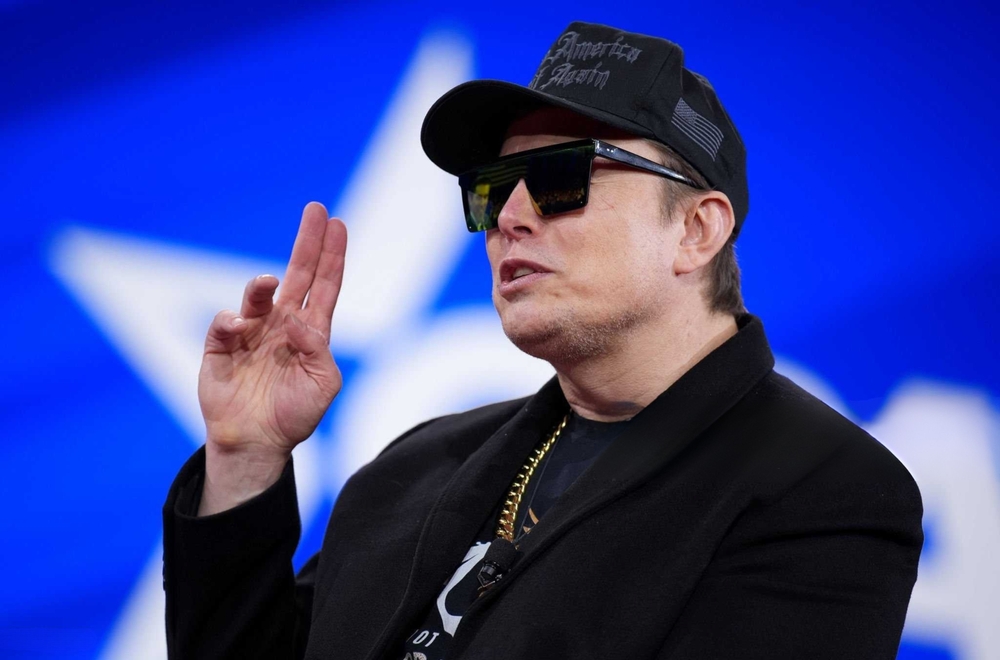

Elon Musk has spent more than a decade warning the world that artificial intelligence could destroy it. Then last week, sitting across from The Economist‘s editor-in-chief at Tesla’s Texas Gigafactory, he said something that complicates that picture considerably: he has made peace with pressing ahead anyway.
That’s not a small thing to say. Musk has spent years calling AI akin to “summoning the demon” and more dangerous than nuclear weapons, and as recently as October 2025 on The Joe Rogan Experience, he estimated the probability of catastrophic AI outcomes at around 20%. Those positions didn’t disappear in the July 23 interview. What changed is the conclusion Musk draws from them.
“My sort of philosophical conclusion is to look on the bright side,” Musk told The Economist. “I can’t see any way to really stop this incredible momentum of AI and robots,” he said. For the man who once helped found the Center for AI Safety and spent years sounding alarms, that’s less a reversal than a resignation, and a bet that the train is going somewhere worth riding.
The Musk AI Warning That Has Shifted
The Economist interview, published July 23, 2026, was Musk’s first extended public conversation since SpaceX’s blockbuster IPO, which gave the exchange extra weight. SpaceX went public on June 12, 2026, in a historic market debut that pushed the company’s market cap above $2 trillion. Musk arrived at the interview as arguably the most commercially successful person in the world, and he spoke accordingly, with the confidence of someone who has decided the debate is essentially over.
He told The Economist he couldn’t see any way to stop the momentum of AI and robots, and predicted that humans would “no longer be in charge of the world in 10 years,” describing a future in which artificial intelligence exceeds human capabilities across most domains.
The chimpanzee analogy he used to explain that prediction has stuck with observers. Musk maintained that the risk of AI-driven catastrophe remains between 10% and 20%, according to the July 2026 interview. The implication he drew, consistent with what he’s said privately for years, is that when the intelligence gap between AI and humans becomes as wide as the gap between humans and chimps, the question of who controls the trajectory becomes almost rhetorical.
While that 10-20% risk assessment has remained broadly unchanged, his latest comments suggest a shift in how he believes society should respond to the technology’s rapid development. The risk hasn’t shrunk in his estimation. His threshold for action has just moved.
What Musk Is Actually Predicting
Strip away the provocation and the interview delivers a specific timeline. Musk predicts AI will surpass the sum of human intelligence within five years, leading to a future of incredible abundance by 2036. That benchmark, sometimes called artificial general intelligence, or AGI, meaning AI that can outperform humans at essentially any cognitive task, has been debated by researchers for decades. Musk is now treating it as a near-certainty within this decade.
The economic picture he’s painting alongside that timeline is striking. Musk told The Economist’s editor that “money won’t matter in 2036,” arguing that robots and AI will produce more goods and services than any person could consume, at which point currency stops being useful.
He’s been building toward that argument throughout 2026. Musk has been making versions of the abundance argument more explicitly this year. In January he said saving for retirement would be “irrelevant” in a world of abundant AI and robotics. More recently he predicted that AI and robots would make work optional and fund what he called “universal high income,” a concept he’s described as a world where scarcity is no longer the default condition of human life.
Universal high income differs from universal basic income in one important respect: Musk frames it not as a safety net, but as a surplus. He acknowledged the transition would be bumpy and said income transfers were likely the next big political battle. The concern many economists raise is the gap between that future abundance and the job losses that arrive first, because workers displaced by automation don’t wait for prices to fall.
The Risk He’s Choosing to Accept
The part of Musk’s position that most demands scrutiny is not the optimism, it’s the arithmetic. He continues to put meaningful odds on catastrophic failure while simultaneously arguing for full acceleration. When asked about the prospect of killer robots annihilating humanity, Musk put the odds at “20% likely, maybe 10%” then added that you could look at it as the glass being 80-90% full, with an 80% likelihood of extreme prosperity for all.
That framing, betting on an 80% chance of prosperity while accepting a 10-20% chance of catastrophe, isn’t irrational if you genuinely believe the alternative is watching someone else make the same bet. Musk also said during the interview that China has a strong chance of leading AI once it expands its computing capacity, and sees the geopolitical competition as unresolved, which explains much of his logic. If a powerful AI is coming regardless, the argument runs, it’s better to have safety-focused developers at the front than to cede that ground.
Geoffrey Hinton, the Nobel Prize-winning computer scientist often referred to as one of the pioneers of modern AI, has estimated a 10-20% chance of AI contributing to human extinction over the next three decades, speaking on BBC Radio 4. Hinton has used that figure as a reason for caution and government regulation, not acceleration, which puts him in direct philosophical tension with Musk’s current position.
The research community’s concern runs considerably deeper. A March 2026 study conducted at Harvard University, surveying attendees of a public event on AI existential risk, found that the post-event median estimate of the probability of existential risk from advanced AI was 70%, and 96% of participants agreed that mitigating AI existential risk should be a global priority. That survey involved self-selected respondents already concerned about the topic, which limits how broadly the figure can be generalized, but the direction of the finding is consistent with a growing body of expert opinion.
You can find more on how AI-driven economic shifts are reshaping daily life in this Hearty Soul breakdown of the AI boom.
The Tension No One Has Resolved
Musk’s recent interview with The Economist ranged widely, from the future of artificial intelligence to his political interests, with the common thread being an unshakeable belief in his own predictive skills. “My batting average is very high for a human,” he told editor Zanny Minton Beddoes.
That self-assurance has commercial implications worth noting. Tesla, xAI, and several of his other companies continue investing heavily in artificial intelligence, making his public outlook closely aligned with the technologies underpinning those businesses. A bullish public stance on AI is also, inescapably, bullish on Musk’s own portfolio.
When told during the interview that “people loathe you,” Musk replied “I don’t care,” before criticizing media coverage of his businesses and public statements. It was the kind of exchange that tends to generate heat rather than light, but it underscored something real about where Musk sits right now. He’s not asking for permission, and he’s not particularly worried about persuading skeptics.
His latest comments reflect an evolution in emphasis rather than a reversal of his long-held concerns. He still thinks the risk is real. He’s just concluded that the only move is forward.
Read More: How Humanity Could End, According to Scientists
What This Means for You
The Musk AI warning, in its 2026 form, is different from the earlier versions. The 2014 demon-summoning metaphor was a call to pause and regulate. The 2026 version is a call to prepare. If his timeline is even roughly right, the economic and social disruptions he’s describing, widespread job displacement, the political battles over income transfers, the possibility of money itself becoming less central to daily life, could begin materializing within a decade.
That doesn’t mean taking Musk’s 2036 predictions at face value. His timelines have historically run optimistic, and the abundance he describes presupposes a distribution of AI benefits that hasn’t been politically or economically resolved. The Economist’s Zanny Minton Beddoes challenged him directly on the political gap: job losses from AI tend to arrive before abundance does, workers displaced by machines don’t sit around waiting for prices to fall, and they put pressure on governments.
What’s actionable is simpler than the philosophical debate: pay attention to how your work, savings strategy, and skills intersect with accelerating automation, not in a decade, but now. The workers and sectors most exposed to AI displacement aren’t waiting for 2036 to feel the pressure. And whether Musk’s 80% or 20% number turns out to be right, the disruption in between will be real regardless.
AI Disclaimer: This article was created with the assistance of AI tools and reviewed by a human editor.