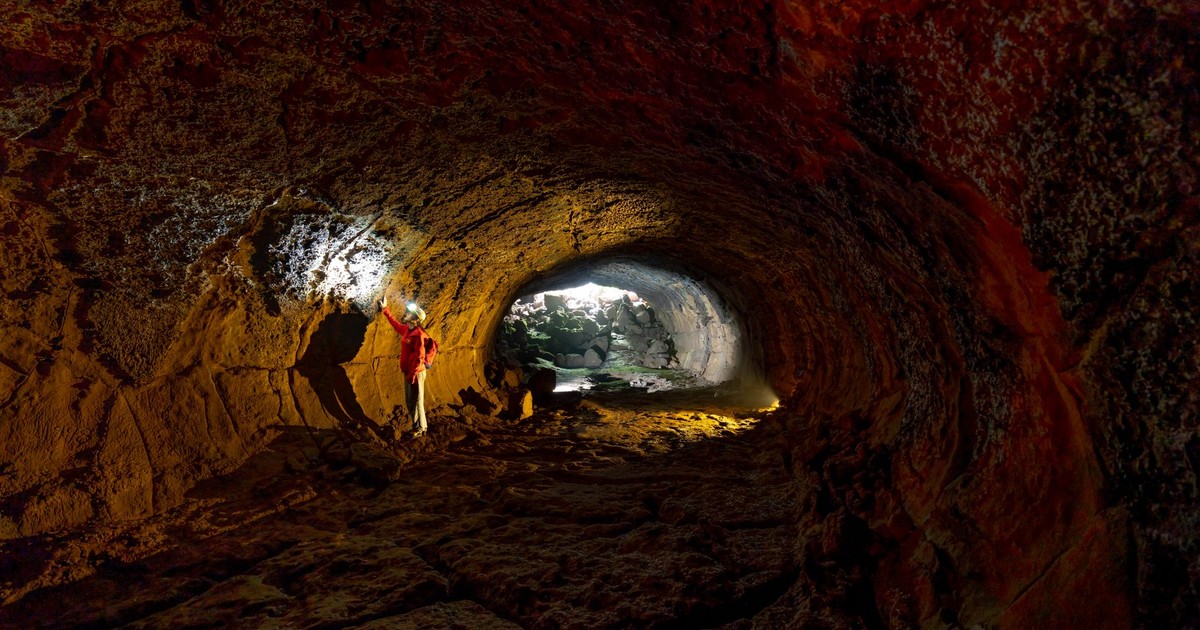

Bobcat Cave sits just eight miles from a university campus and has been visited by scientists every quarter for more than thirty years. In February 2025, a biologist slipped in the mud, tumbled into a deeper pool, and startled a fish he had never seen before. That accident is now part of the formal scientific record.
The creature he disturbed turned out to be a new genus of vertebrate, hiding in one of the most systematically monitored cave systems in the eastern United States. Its closest known relatives are fish studied since the 1800s. The tools to detect it, the genetic sequencing and CT imaging equipment that confirmed it was something entirely different, had been accessible for years. The will to look for something new, in a cave believed to be fully cataloged, apparently hadn’t been there.
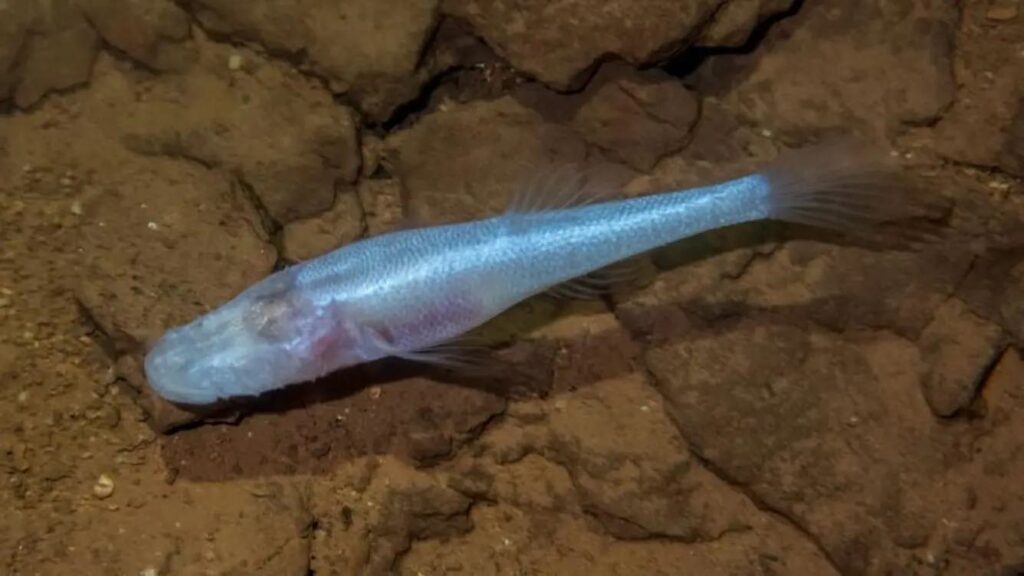
The demon cavefish, formally named Demogorgonichthys arcanus, is eyeless, colorless, and faintly electric blue in life. Beneath its translucent skin, you can see its brain. That detail alone tends to confirm, fairly quickly, that you are not looking at something previously described.
A Discovery in Plain Sight: The Setting of Bobcat Cave
The demon cavefish was first documented at Bobcat Cave, located on Redstone Arsenal near Huntsville, Madison County, Alabama, during biological surveys conducted in February 2025. The findings were published July 6 in Scientific Reports. The study was led by Dr. Matthew L. Niemiller, associate professor in the Department of Biological Sciences and director of the Cave Bio Lab at the University of Alabama in Huntsville (UAH), in collaboration with researchers from Auburn University, The University of Alabama, Mississippi State University, Redstone Environmental, and students from the Cave Bio Lab. Niemiller had surveyed Bobcat Cave many times before. He expected to find the Alabama cave shrimp, two species of cave crayfish, and the Southern cavefish. He did not expect to find a new genus of vertebrate hiding among them.
The site’s history makes the discovery arresting. As Niemiller noted, “This is a site that has been monitored at least quarterly for more than 30 years. Cavefishes in this family have been a model system for cave biology since the 1800s.”
Bobcat Cave is already known for housing the endangered Alabama cave shrimp. Since 1990, the cave has been the focus of water quality monitoring, shrimp surveys, and other biological investigations. Monitoring infrastructure, federally mandated because of the shrimp’s endangered status, effectively meant scientists were walking past a new genus of vertebrate with every quarterly visit. The demon cavefish wasn’t lurking in a remote corner. As Niemiller put it, most researchers had assumed a genus-level discovery was increasingly unlikely, and “to find one, not in some remote, unexplored cave, but in Bobcat Cave, was humbling.”
The study noted that undiscovered species may take refuge in access-restricted lands such as military installations. Bobcat Cave is beneath the U.S. Army’s Redstone Arsenal. Limited public access to military land may, paradoxically, have created a quiet refuge where rare subterranean life went undetected.
Anatomy and Physical Characteristics of the Demon Cavefish
The newly described demon cavefish (Demogorgonichthys arcanus) is completely eyeless, colorless, and faintly electric blue in life. That electric-blue tint is one of its more disorienting characteristics: an animal with no pigmentation that nonetheless carries a spectral shimmer. The property has been observed in other depigmented cave species and relates to light-scattering through translucent tissue rather than any true coloration.
The fish’s body plan is distinct from any described cavefish in the Amblyopsidae family (the North American cave fish family to which it belongs). It features a hunchback, spiny rays, and a snout shape unlike that of other cavefish species. The fish completely lacks pigment; beneath its translucent skin, you can see its brain. Dr. Jonathan Armbruster, curator of fishes at the Auburn University Museum of Natural History and a coauthor of the discovery study, noted that this kind of transparency is most commonly seen in smaller fishes and things that live in open water.
Phylogenetic analyses using the mitochondrial nd2 gene, complete mitochondrial genomes, and the nuclear gene rhodopsin place D. arcanus within the Amblyopsidae but reveal deep divergence from all described genera, including extensive lineage-specific degeneration of a vision-related gene. The fish’s genome shows not just that it has lost its eyes, but that the molecular machinery for vision has been dismantling itself, gene by gene, over a very long period of time.
The Mistaken Identity Problem: Why It Stayed Hidden
The demon cavefish escaped detection because it closely resembles another blind species already known from the cave, the Southern cavefish (Typhlichthys subterraneus). Detailed anatomical studies, CT imaging, and genetic analyses ultimately revealed the new fish to be something entirely different.
Initially, Niemiller was uncertain whether the fish belonged to the southern cavefish. “Over the years, I’ve seen how variable cavefish can be, and I’ve been fooled before by animals that looked different but were genetically very similar,” Niemiller said. “But this one was different in ways that kept holding up.”
CT imaging allowed researchers to map the skeletal structure of the fish in three dimensions without destroying the specimen, a method now standard in taxonomic work on small or delicate vertebrates. The genetic data, drawn from multiple gene regions including the full mitochondrial genome, confirmed that the animal belonged to a lineage that had split from all known cavefish genera long before either the cave or the Alabama cave shrimp monitoring program existed. The cave had been hiding a distinct evolutionary lineage for millions of years, and the tools to detect it only recently became accessible enough, and cheap enough, to deploy in routine biological surveys.
Convergent Evolution: Two Paths to the Same Dark World
D. arcanus occurs in syntopy with the Southern cavefish (Typhlichthys subterraneus) despite lacking a close phylogenetic relationship, providing evidence for multiple independent evolutionary origins of cave adaptation within a single groundwater system. Syntopy means the two fish share the same habitat, literally the same pools, yet their resemblance is a product of independent evolution rather than common ancestry.
As Niemiller explained: “Each found its own separate way into the underground world and lost its eyes and pigment independently, millions of years apart. It’s a vivid case of convergent evolution.” Convergent evolution describes the process by which unrelated species independently develop similar traits in response to similar environmental pressures. The cave environment, with its perpetual darkness, scarce food, stable temperatures, and absence of visual predators, applies identical selective pressures to any fish lineage that enters it. Eyes become costly to maintain and are gradually lost. Pigmentation, similarly without benefit, fades. Two completely unrelated fish, separated by millions of years of evolutionary history, end up looking almost identical.
Dr. Suzanne McGaugh, a professor at the University of Minnesota who studies the evolution of cavefish, described discoveries of new North American vertebrate species such as the demon cavefish as “exceedingly rare,” and called it remarkable that two cavefish species live in the same cave despite evolving through separate journeys from different ancestors.
This pattern is not entirely new to Amblyopsidae. Genomic analyses suggest that amblyopsids independently colonized caves and degenerated their eyes multiple times after descending from populations that already possessed adaptations to low-light environments. The demon cavefish adds another documented chapter to that story, from a cave that scientists believed was already fully characterized.
The Naming: Demogorgon, Stranger Things, and Scientific Etymology
The genus name, Demogorgonichthys, references the mythological Demogorgon, an underworld figure familiar to modern audiences through the game Dungeons & Dragons and the television series Stranger Things. Combined with the species name arcanus, meaning “hidden” or “secret,” the scientific name reflects both the fish’s subterranean habitat and its decades-long concealment in one of Alabama’s best-known cave systems.
In Stranger Things, a monster named Demogorgon stalks the fictional town of Hawkins, Indiana. The origins of the word Demogorgon are unclear; while scholars theorize that it has Greek roots, the creators of the role-playing game Dungeons & Dragons, which debuted in the 1970s, adopted the name for a villain. Decades later, Netflix used it for the Stranger Things monster. The name’s application to a pale, eyeless predator living in underground darkness needs little explanation.
Taxonomy convention requires that genus names be globally unique and, where possible, descriptive or culturally meaningful. Demogorgonichthys (“Demogorgon fish”) satisfies both criteria. It is also a name that will almost certainly outlast the television series that partly inspired it, attached now to a real organism, formally described in peer-reviewed literature, and permanently embedded in the scientific record.
Rarity, Conservation Status, and the Stakes of This Discovery
The exact population size of the demon cavefish remains unclear, but it may be among the rarest fish in the world. “The species is known from a single site based on our best knowledge with presumably a very small population size,” Niemiller wrote. The most recent field count offered a sobering data point: the last time Niemiller was in Bobcat Cave, he counted 27 demon cavefish, a number that likely isn’t the full population size but does not convey security either.
Twenty-seven visible individuals is not the same as twenty-seven total; cave fish frequently shelter in aquifer passages far beyond the reach of a survey lamp. But the recharge basin, which influences the amount and quality of groundwater entering the system, is “very small,” according to Armbruster, indicating that the demon cavefish is likely critically endangered.
The existing protection infrastructure for the Alabama cave shrimp, enforced under the Endangered Species Act, provides some degree of indirect protection for the newly discovered fish. As Niemiller noted, what protects the shrimp’s water protects the fish’s water too. But that protection was designed around a different species, and it offers no guarantee that the demon cavefish’s specific habitat requirements and population dynamics are being adequately monitored. Formal endangered species designation, if pursued, would require its own survey protocols and threat assessments.
The broader implication the research team flagged is significant. Subterranean ecosystems host highly specialized and often cryptic biodiversity, yet even intensively studied landscapes may conceal deeply divergent vertebrate lineages. If a new genus of fish can remain undetected for three decades of quarterly monitoring in a cave eight miles from a university, the assumption that major cavefish discoveries are “behind us” collapses.
Read More: Scientists discover a new scary-looking fish
What This Means for Biodiversity Science
In Niemiller’s words, “Finding an entirely unknown, new genus of freshwater fish in eastern North America today is a little like finding a new kind of big cat. The group is so well known, we thought the big surprises were behind us.” The Amblyopsidae family has been studied since the 19th century and is among the most intensively examined groups in North American freshwater biology. A new genus, not a new species within a known genus, but an entirely new genus, represents a level of divergence that taxonomists find genuinely startling.
A 2025 time-calibrated phylogenetic study published in Molecular Biology and Evolution estimated that crown Amblyopsidae originated in the late Oligocene approximately 24.46 million years ago, followed by the divergence of all major cavefish lineages between 19.8 and 11.46 million years ago. The demon cavefish’s deep divergence from all known genera suggests its own ancestral lineage branched off from the others many millions of years ago, long before any human ever set foot in North America.
This discovery also reopens a methodological conversation about how biodiversity surveys are conducted. Morphology-based identification, classifying animals by how they look, will consistently fail to detect cryptic species that look nearly identical but are genetically distinct. McGaugh herself, who studies cavefish evolution at Minnesota, has noted that individual populations of cavefish appear to have lost their sight in independent evolutionary events, meaning the patterns observed in D. arcanus fit a broader picture of convergence playing out in the dark. Niemiller, when asked whether additional undescribed species might exist in the region’s cave systems, answered simply: “Almost certainly, yes.”
The demon cavefish case demonstrates concretely that restricted-access sites, including military installations, private land, and gated karst systems, may harbor undocumented vertebrate diversity precisely because they have been visited less frequently, or visited without the molecular tools to detect cryptic lineages. Future surveys in similar environments, combining eDNA sampling (environmental DNA, genetic material shed into the water by living organisms), CT imaging, and full genomic analysis, will almost certainly yield additional surprises.
What This Means for You
The discovery of Demogorgonichthys arcanus carries implications that extend well beyond northern Alabama. Described formally as a new genus and species of cave-obligate fish from Bobcat Cave, a long-monitored karst system on Redstone Arsenal, it proves that even rigorously studied ecosystems can conceal deeply divergent life. The combination of the animal’s physical distinctiveness – its hunchback, spiny rays, translucent brain-revealing skin, and faint electric-blue coloration – with its genetic distance from all known cavefish genera makes it one of the most significant freshwater fish discoveries in North American science in recent decades.
The fish’s conservation situation demands immediate attention. A species known from a single cave site, with a recharge basin described as “very small,” and a visible field count in the dozens, is a species operating at the very edge of viability. The groundwater protections already in place for the Alabama cave shrimp provide a partial buffer, but a formally assessed conservation plan specific to D. arcanus is the logical next step. Dr. Suzanne McGaugh at the University of Minnesota described discoveries like this one as “exceedingly rare.” The fish has been hiding for millions of years. It deserves the chance to keep doing so.
AI Disclaimer: This article was created with the assistance of AI tools and reviewed by a human editor.
Read More: 2,000-Year-Old ‘Jesus Boat’ Discovered Near the Sea of Galilee