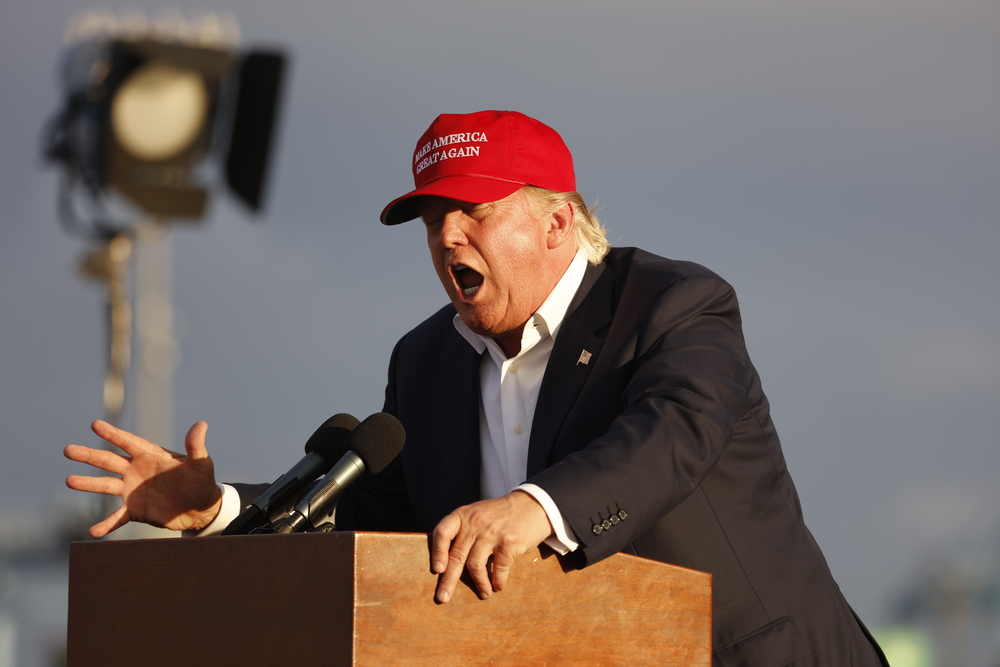

At a General Motors facility in Milford, Michigan, President Donald Trump paused mid-speech last Monday to declare that his late father, Fred Trump, “didn’t want planes” – and then added, almost as an aside: “They didn’t have planes in those days, I don’t think.”
Fred Trump was born in 1905 and died in 1999. The Wright brothers had completed the first successful powered flight in December 1903, approximately two years before Fred was even born, according to the National Park Service. Commercial aviation didn’t just exist during Fred Trump’s life – it flourished, spanning the rise of transatlantic passenger jets and supersonic travel. The math isn’t close. And yet, standing before a crowd of autoworkers, the President of the United States appeared to suggest otherwise.
Trump made the comment while addressing workers at the General Motors facility in Milford, Michigan, where he promoted his administration’s economic and automotive policies. He stopped at a mint-condition 1957 Cadillac Eldorado and told the story about how his father, Fred Trump, loved Cadillacs and purchased a new one every few years. The anecdote veered quickly into territory that left observers puzzled, and once the clip spread online, the Trump Alzheimer’s speculation that has followed the president for months intensified again.
Trump himself acknowledged the digression in real time. It suddenly seemed to dawn on him that he was off-topic, prompting him to reference his famously rambling manner of address, saying, “Just to mention, you know, it’s called the weave, right? I go from one – we always get back to the right subject.” That self-aware pivot did little to quiet the reaction.
What “The Weave” Actually Is – and Why It Matters
Trump has been using the term “the weave” to describe his own speaking style since at least 2024. He calls his style “the weave,” whipsawing from dystopian warnings to light-hearted storytelling to policy pronouncements, and explained it to podcaster Joe Rogan by saying, “I weave stories into it.” The idea, as Trump frames it, is that multiple seemingly unrelated threads eventually converge into a coherent point.
Critics and linguists have pushed back on that interpretation. Columbia University linguist John McWhorter, who wrote about the weave in The New York Times, acknowledged Trump “is not completely out of his mind” in describing his casual conversational style, since most people aren’t highly organized in the heat of speech. But McWhorter drew a meaningful distinction. What he hears is “verbal narcissism” – the connection between point A and point B is often very difficult to understand, requiring listeners to parse it almost like a Talmudic text, whereas it makes sense to Trump. His conclusion: “I don’t think it’s dementia.”
New York Times senior political correspondent Maggie Haberman offered a sharper read. Speaking on CNN, she said Trump calling his speech patterns “the weave” is just “PR to try to explain why he’s talking this way.” At the Milford speech alone, Trump departed into extended digressions about his father’s Cadillac purchasing habits, daylight saving time legislation, a cabinet member’s tree-climbing history, a Michigan lawn-grass donor, and a story about a Las Vegas waitress – with Trump naming the tangential style mid-speech, treating it as an established feature of his delivery rather than a lapse to correct.
The Family History That Keeps Surfacing
What makes the planes comment particularly resonant for those tracking Trump’s cognitive health is his father’s documented medical history. Fred Trump Sr. was diagnosed with “mild senile dementia” in 1991, with his physician citing symptoms of “obvious memory decline in recent years” and “significant memory impairment.” He was later hospitalized with pneumonia and died at age 93 in 1999.
Fred Trump III, the son of Donald Trump’s late brother, Fred Trump Jr., addressed the family’s history directly in his memoir, All in the Family: The Trumps and How We Got This Way, published in 2024. In the book and in subsequent interviews, he described his grandfather’s Alzheimer’s disease in detail. In an appearance on SiriusXM’s “The Dean Obeidallah Show,” Fred Trump III recalled his grandfather’s decline beginning in the 1980s, with early signs that included getting out of his limousine and simply walking away without explanation. In a more recent interview, Trump’s niece Mary Trump laid out what she described as the clearest case she has ever made that the president is showing the same signs she once saw in his father, who had Alzheimer’s disease “for a very, very long time.”
For readers wondering whether that family history carries biological weight, the Alzheimer’s Association is unambiguous on the point. Family history can influence risk, and having a parent or sibling diagnosed with Alzheimer’s makes you more likely to develop the disease. The mechanism depends on which type of gene is involved. Risk genes, like APOE e4, increase the likelihood of late-onset Alzheimer’s but are no guarantee, while deterministic genes are linked with early-onset disease and carry near-certainty. Donald Trump has not publicly disclosed the results of genetic testing for either gene variant.
A Debate That Won’t Stay Private
The Trump Alzheimer’s speculation reached a more vocal phase earlier this year. Over recent weeks, speculation has grown about Trump’s erratic behavior, with various commentators suggesting he may have malignant narcissism, Alzheimer’s disease, or frontotemporal dementia, and is experiencing accelerating cognitive decline and a “profound psychological crisis.” Frontotemporal dementia, or FTD, is a group of progressive brain disorders that attack specific regions of the brain and can affect judgment, empathy, language skills, and impulse control. It is worth noting that none of the commentators below have examined Trump clinically, and their observations carry the weight of informed opinion rather than clinical diagnosis.
Dr. John Gartner, a clinical psychologist and former assistant professor at Johns Hopkins University Medical School who has publicly tracked Trump’s behavior for years, told The Daily Beast that he has observed deterioration across four areas he considers central to a dementia assessment: language, thinking, physical condition, and behavior. He also linked Trump’s late-night social media posting to possible clinical symptoms, suggesting the pace of it could point to “mania or sundowning,” or a combination of both.
The journalist Joanna Coles, chief content officer at The Daily Beast, made a direct comparison in recent episodes of the podcast The Daily Beast Podcast (also known as Inside Trump’s Head). Coles, who is not a clinician, pointed directly to Trump’s family history and discussed the president’s rhetoric alongside Gartner. Author Michael Wolff, also not a clinician, has similarly weighed in on the question of Trump’s mental sharpness in public commentary.
NBC News medical analyst Vin Gupta, a pulmonologist, also weighed in earlier in 2026. Gupta stated that Trump’s behavior “crossed a line of proper adult behavior” and should prompt “a more thorough public assessment of his neurological fitness,” adding that what he observed could be signs of early Alzheimer’s or frontotemporal dementia.
The White House has consistently rejected these characterizations. Trump’s physician, Navy Capt. Sean Barbabella, declared Trump to be in exceptional health and fully fit to execute the duties of president, noting that Trump achieved a perfect score on a cognitive assessment during his April 2025 exam. The test in question is the Montreal Cognitive Assessment, a widely used screening tool designed to detect early signs of mild cognitive impairment and dementia. Trump has now taken the assessment at least four times on the public record – in 2018, April 2025, around October 2025, and again in May 2026 – each time returning a perfect score.
The problem identified by clinical critics is not the score itself, but what the test can and can’t detect. Proper frontotemporal dementia diagnosis is complex and cannot rely on observation alone. A multidisciplinary clinical team must examine the person’s personal and medical history, followed by neurological examinations, formal cognitive testing, and brain imaging such as MRI or PET scans to identify structural and functional changes in the brain.
Read More: Trump Dementia: What’s Behind the Health Concerns in 2026
Medical ethicists have added a complicating layer to the debate. Diagnosing someone with this condition from afar is, according to medical ethicists writing in The Conversation, “not only irresponsible – it’s impossible,” and may inadvertently give Trump an “out” for offensive but intentional behavior, while increasing stigma for those who actually live with dementia. Medical experts generally caution against attempting to diagnose individuals based solely on publicly observed behavior or social media activity.
Dementia encompasses a spectrum of disorders, including Alzheimer’s disease and vascular dementia, each requiring rigorous clinical criteria. Observable speech repetition or rhetorical style, particularly in political rallies, does not automatically equate to pathology.
What to Do With All of This
The planes comment may turn out to be exactly what some supporters say it is: a verbal shortcut that came out wrong, a president who misspoke mid-anecdote and caught himself. Trump does it by his own admission, having described and branded the habit. The Milford speech was, by most accounts, a meandering one – the visit came less than 100 days before midterm elections, and Trump told the GM crowd he was the first sitting president to tour the facility, which opened in 1924 as the world’s first dedicated vehicle testing facility. There were plenty of other moments from the event that drew attention alongside the planes remark.
The Trump Alzheimer’s speculation doesn’t hang on any single comment – it accumulates through a documented family history, repeated public behaviors that observers flag as atypical, and a formal medical record that answers some questions while leaving others unanswered. The absence of updated and detailed medical disclosures leaves space for speculation; in the absence of direct clinical evidence, assertions of dementia remain unproven.
For anyone concerned about cognitive health in their own family, the clearest takeaway from research is actionable: having a first-degree relative with Alzheimer’s raises your risk meaningfully, but lifestyle factors can significantly modify that risk. A study tracking healthy behaviors found that participants who adopted four or five healthy habits showed a 60% lower Alzheimer’s risk compared to those following none or one, with each additional healthy lifestyle factor decreasing risk by 22%. Sleep quality, cardiovascular health, and managing blood pressure are among the most consistently supported protective factors in the research.
As for what’s actually happening inside the mind of a president who thinks planes didn’t exist in 1905: no one outside his clinical team knows. What the public has is a clip, a pattern, and a debate that’s unlikely to end any time soon.
Disclaimer: The information provided here is for educational and informational purposes only and is not a substitute for professional psychological, psychiatric, or mental health advice, diagnosis, or treatment. Always seek the guidance of a licensed mental health professional, therapist, psychologist, or psychiatrist with any questions or concerns about your emotional well-being or mental health conditions. Never ignore professional advice or delay seeking support because of something you have read here.
AI Disclaimer: This article was created with the assistance of AI tools and reviewed by a human editor.