

Every student who walked into Troy High School on the morning of February 14, 2017, found something waiting on their locker. Not a notice. Not a grade. A handmade origami heart – folded from colorful cardstock, with three words written in black permanent marker on the front: “You are loved.”
Nobody knew who did it. That was the point.
Behind the gesture was a single anonymous student who had been quietly folding and writing since September – five months of working in secret, storing each finished heart in her closet at home so nobody would find out. She told Principal Katherine Weaver she came up with the plan in the fall and had been working on the origami hearts since September. She hadn’t told anybody – not even her parents. She used a calendar to track how many she needed to complete each day to finish in time. That level of planning, sustained across months, for the sole purpose of making sure no one felt invisible on a day that can feel deeply exclusionary, is the kind of thing that deserves more than a viral Facebook post.
This student valentine project is one of the most instructive acts of youth-led mental health advocacy in recent memory. Not because it made headlines, but because it understood something that policy documents, school counselors, and well-funded wellness programs frequently miss: belonging isn’t a program. It’s a feeling. And sometimes all it takes to create it is evidence that someone thought of you.
What One Student Understood About Loneliness
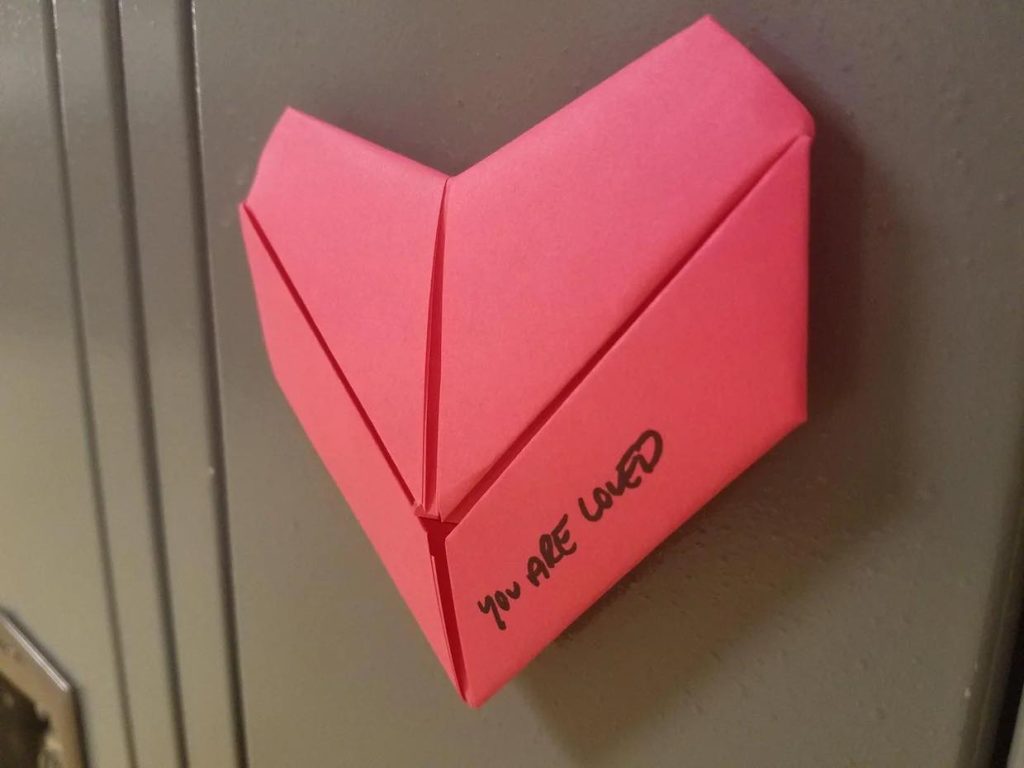
Principal Weaver confirmed that the anonymous student left origami hearts reading “You are loved” on each of the school’s roughly 1,300 lockers. Staff members’ mailboxes were also filled with personal notes, so nobody in the building was excluded. The student had help taping the hearts to lockers the night before Valentine’s Day, but she folded every single piece of cardstock herself.
What makes this student valentine project remarkable isn’t the scale, though 1,300-plus individually folded hearts is genuinely extraordinary. It’s the instinct driving it. This student recognized that Valentine’s Day – the one day schools nominally dedicate to affection – routinely sorts students into two camps: those who receive something and those who don’t. She decided, months in advance, to eliminate that divide entirely.
Principal Weaver told CBS News: “To have someone so dedicated to every single person in this building – that’s just an amazing quality for anybody to have, especially a high school student.” Weaver saw the student and a handful of helpers after school on Monday, tirelessly pasting the handmade valentines one by one.
That instinct maps directly onto what the data tell us about adolescent mental health. According to a 2025 data brief from the CDC’s National Center for Health Statistics, the prevalence of depression in U.S. adolescents and adults increased 60% over the past decade. Depression prevalence is highest in adolescents ages 12 to 19, at 19.2%. Nearly one in five teenagers is depressed. One anonymous girl in Ohio, armed with cardstock and a marker, was responding to a reality she felt even if she couldn’t have cited those numbers.
The Science Behind a Simple “You Are Loved”
A survey of approximately 1,100 U.S. college and university students found that nearly two-thirds – 64.7% – report feeling lonely, and students who feel lonely are over four times more likely to experience severe psychological distress. That data comes from a 2024 survey by Active Minds and TimelyCare, conducted in February 2024. The numbers are striking on their own, but the mechanism behind them is what makes the Troy High School story feel like more than symbolism.
Research on school belonging gives the clearest window into why a handwritten heart on a locker can carry real weight. A 2024 study in the journal Child Development found that school connectedness predicted fewer mental health problems and greater positive mental health in young people. Feeling seen within a school community isn’t a soft outcome. It functions as a buffer. Students who feel connected to their school are measurably less likely to internalize problems – anxiety, depression, self-doubt – or to act out in ways that harm themselves and others.
The American Psychiatric Association has noted that performing acts of kindness may help reduce symptoms of depression and anxiety, and that deliberate gestures of inclusion produced meaningful benefits for social connection in controlled research. The anonymous student at Troy wasn’t doing therapy. She was doing something arguably harder to manufacture at scale: she was making each person feel individually considered. She wrote on each heart by hand. She used a calendar. She hid everything in her closet. The effort itself communicated something the three printed words couldn’t fully contain.
The Strongest Case Against Making This Matter
The most credible objection to elevating this story is that individual kindness, no matter how moving, can’t substitute for systemic change. A 60% increase in adolescent depression over a decade is not a problem that origami hearts can solve. Schools are chronically underfunded in mental health support. Counselor-to-student ratios in many districts remain well above recommended levels. Teens in poverty face compounding disadvantages that a Valentine’s Day gesture can’t touch.
Those objections are real and worth sitting with. Peer-initiated kindness and institutional mental health infrastructure are both necessary – they address different parts of the same problem. What this student’s project did was fill a gap that formal programs rarely reach: a peer, not an adult with a clipboard, decided that nobody in her school should feel forgotten. A 2025 study published in Health Expectations identified peer support as a valuable, low-threshold complement to traditional care, particularly for youth lacking access to formal treatment.
The students who received those hearts didn’t see a wellness initiative. They saw evidence that another teenager – someone navigating the same hallways, the same social pressures, the same calendar – had thought of them by name, or at least by locker number. That’s a different kind of message than a poster on a bulletin board.
What the Numbers Behind Loneliness Actually Mean
During August 2021 through August 2023, 13.1% of U.S. adolescents and adults aged 12 and older had depression in a given two-week period, according to the CDC’s National Center for Health Statistics data brief. For teenagers specifically, that figure climbs significantly higher. And depression rarely arrives alone. It travels with isolation, with the sense that the people around you are connected to each other in ways that don’t include you.
The Active Minds and TimelyCare survey found that college students who report feeling lonely are over four times more likely to experience severe psychological distress. Loneliness isn’t a mood. It functions physiologically. Research published in a 2025 review found that loneliness has been linked to elevated cortisol levels and increased systemic inflammation – the kind of chronic stress response that, sustained over time, damages cardiovascular health and immune function. A separate 2025 analysis in the European Heart Journal found that both loneliness and social isolation are associated with increased cardiovascular disease risk.
High school students are living these numbers. According to the CDC’s 2023 Youth Risk Behavior Survey, 40% of U.S. high school students reported persistent feelings of sadness or hopelessness. Nearly half. The majority of them were sitting in the same schools, passing the same lockers, being graded on the same tests, without anyone formally acknowledging that they might be struggling.
One student in Troy, Ohio changed that calculus – at least for one day – with paper, a marker, and five months of quiet determination.
Read More: Not so random acts: Science finds that being kind pays off
What This Means for You
The story of this student valentine project doesn’t call for grand gestures. It calls for intentionality – the decision to include someone rather than overlook them. The anonymous student at Troy didn’t have a mental health credential or a school budget. She had cardstock, a calendar, and the conviction that everyone around her deserved to feel seen.
Peer-expressed belonging reduces loneliness. Reduced loneliness correlates with lower rates of severe psychological distress. Acts of kindness, when deliberate and inclusive rather than performative, improve social connection in ways that formal interventions sometimes can’t match. The mechanism is real, even when the medium is folded paper.
If you work in a school, coach a team, manage an office, or simply know someone who tends to go unnoticed – the lesson from Troy isn’t complicated. The anonymous student used a calendar to track her daily quota so she’d finish in time. She didn’t wait for a program or a policy. She identified a gap and filled it herself, one heart at a time. That’s a model worth following, whether the medium is origami, a text message, or simply saying someone’s name in a room where they’re used to being invisible.
Disclaimer: The information provided here is for educational and informational purposes only and is not a substitute for professional psychological, psychiatric, or mental health advice, diagnosis, or treatment. Always seek the guidance of a licensed mental health professional, therapist, psychologist, or psychiatrist with any questions or concerns about your emotional well-being or mental health conditions. Never ignore professional advice or delay seeking support because of something you have read here.
AI Disclaimer: This article was created with the assistance of AI tools and reviewed by a human editor.