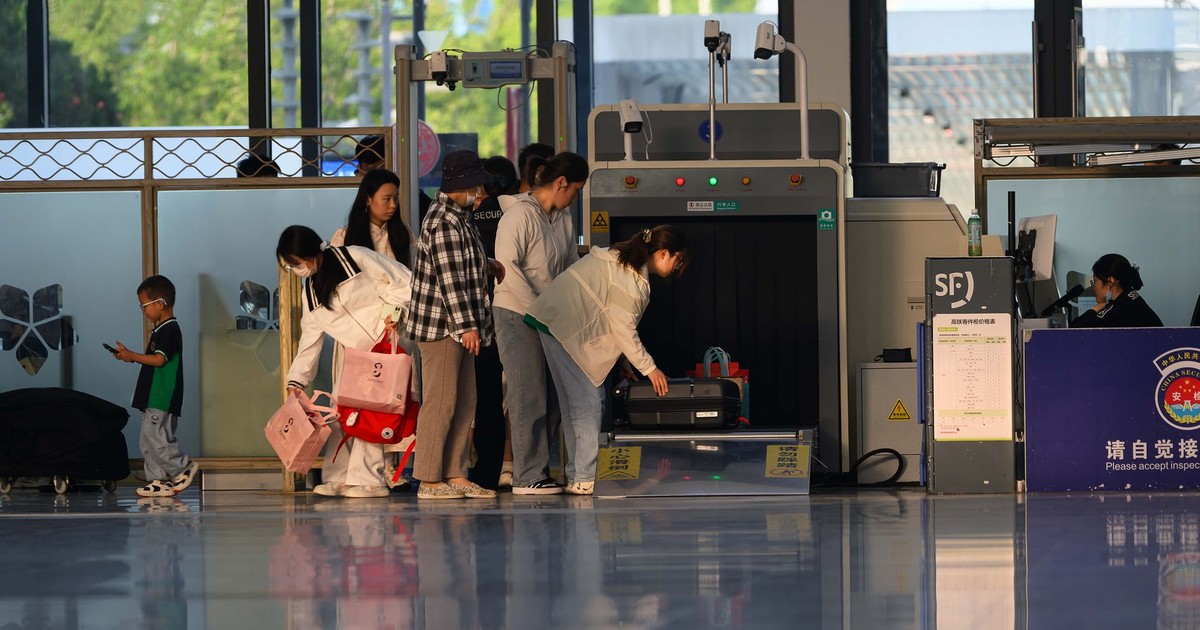

A TikTok video posted by @miakknhagw6 showing a suitcase moving through a TSA scanner has racked up millions of views. The footage is unremarkable for the first few seconds. Then the camera pans to a table behind the security glass, where the item in question is sitting – pulled from the bag and waiting for inspection. It’s not a knife, not a firearm, not contraband of any obvious kind. It’s a marathon finisher’s medal.
The medal’s gold design had pointed edges radiating outward in a sun or star shape. When viewed on an X-ray scanner, it looked more like a ninja throwing star – a banned carry-on weapon. The runner had just crossed a finish line. The TSA officer, looking at a glowing star-shaped silhouette on a screen, saw something else entirely.
The runner had to leave the medal behind. The on-screen text they added to the video read, “Not the TSA agent being so annoyed because they have to throw away everyone’s marathon medal because of the spikes RIP.” The post struck a nerve with millions of people who’ve carried a race medal through an airport without ever thinking twice about it.
@miakknhagw6 1 (5)
♬ original sound – miakknhagw6
How Medals Trigger TSA Alerts
The issue isn’t that TSA is targeting runners. A medal, trophy, prop, souvenir, costume piece, or oddly shaped gift may be harmless in context, but if it appears dangerous or resembles a weapon on an X-ray screen, it can still delay screening or be confiscated from a carry-on bag.
X-ray baggage scanners project a beam through the contents of a bag and read the density and shape of every object inside. Officers are trained to flag anything that matches the silhouette of a prohibited item. A spiked medal, rendered flat and metallic on a grayscale screen, can be nearly indistinguishable from a shuriken – the Japanese throwing star that TSA explicitly bans from carry-on bags.
According to the TSA’s own guidelines, throwing stars are prohibited in carry-on bags. They are permitted in checked baggage, provided any sharp objects are sheathed or securely wrapped to prevent injury to baggage handlers and inspectors. A marathon medal doesn’t appear anywhere on TSA’s prohibited items list. But that distinction matters far less than most travelers assume.
Even if an item is generally permitted, TSA policy allows it to be pulled from carry-on luggage if it triggers an alarm, appears to have been tampered with, or poses other security concerns. The final decision rests with the TSA officer at the checkpoint. That officer-level discretion is a core feature of the screening system, not an edge case. It means a beautifully designed race medal with prominent spikes can be confiscated on the spot, regardless of what’s written in any published rule.
The Miami Marathon Warned Runners – and Some Still Lost Their Medals
Race organizers foresaw the problem with the 2024 Miami Marathon’s sun-shaped medal and warned competitors to stash their prizes in checked baggage. Their concerns proved justified – at least one runner had the medal taken away before being allowed to board a flight. As Runner’s World noted, Joe Robinson, founder of Detroit running club WeRun313, ran into trouble while trying to get home.
The warning came directly from Race Director Frankie Ruiz, who told the Miami Herald: “This was proactive on our end. Once we received the initial batch of medals, we thought, Hey, you know what? Someone could misinterpret this.”
In an email to runners obtained by the Miami Herald, the organizers wrote, “Given its design, we have been informed that TSA may not allow the medals to be carried on flights. As such, we encourage you to plan ahead and check your bag with your medal secure inside to avoid potential issues.” Despite this, some runners still ran into trouble at the airport.
Ricky Deane, a 52-year-old from Elmhurst, Illinois, was one runner who had his medal confiscated. Fellow runner Alfred Scaletta reportedly ran into trouble with TSA because the medal had a spinning feature. A spinning star-shaped medal on a scanner screen is, if anything, a more dramatic flag than a stationary one.
This type of problem isn’t unique to marathons. Any trophy, prop, costume piece, or souvenir with an angular or spiky design can create the same situation. Race organizers and travelers with unusual keepsakes face a real calculation: carry it on and risk confiscation, or check it and risk the bag.
The TSA’s Discretion Is Broader Than Most Travelers Realize
The Federal Register’s guidelines on prohibited items confirm that TSA screeners have explicit authority to prohibit an individual from carrying an item into a sterile area or onboard an aircraft if they determine it poses a potential threat – regardless of whether the item appears on a published prohibited list. Published rules set a floor, not a ceiling.
This authority has real consequences for runners, collectors, and anyone flying home from a destination event. The agency’s policy of leaving final screening decisions to individual officers remains a point of contention, particularly for items that occupy a gray area between personal keepsake and potential security concern.
The throwing-star comparison isn’t hypothetical, either. In December 2025, TSA agents at Newark Liberty International Airport confiscated actual ninja throwing stars from a carry-on bag. The small metal bladed weapons had between three and eight points, and agents described the find as “very odd.” Officers who’ve recently handled the real thing are primed to flag anything that resembles it on a screen – including a gold medal from a January race.
Read More: TSA Cracks Down on Unexpected Travel Item: Your Toothbrush
What Runners and Travelers Should Do Now
The practical fix is straightforward: if a medal, trophy, or souvenir has pointed edges, spikes, or an angular star-shaped design, it belongs in checked baggage, not a carry-on.
TSA rules require that any sharp objects in checked baggage be sheathed or securely wrapped to protect anyone who handles the bag. For a medal, that means wrapping it in clothing or bubble wrap and placing it in a hard-sided case or padded pouch before checking the bag. That approach protects both the medal and the people who process luggage.
If a runner genuinely can’t check a bag – perhaps flying carry-on only after a destination race – there are a few other options. Mailing the medal home before flying is one. Some race organizers, including the Miami Marathon, have anticipated the issue and offered to mail medals directly to runners who had them confiscated. Arriving at the airport with extra time also matters: some pointed items, such as knitting needles, ice skates, and cowboy spurs, are allowed in carry-on luggage, but ninja stars, which certain medals closely resemble, are not. A calm explanation at the checkpoint sometimes helps. It doesn’t always work.
Travelers packing any unusual souvenir, costume accessory, or novelty gift should think about how the object would appear as a flat X-ray silhouette, not how it looks in their hand. A decorative item with radiating points or blades, regardless of its actual material or intent, is likely to generate a secondary screening at minimum.
What This Means for You
TSA officers aren’t evaluating the emotional value of an object. They’re considering only whether it can safely travel in the passenger cabin. That’s a useful frame for any traveler packing something out of the ordinary. The months of training that went into earning a marathon medal, or the sentimental weight of a trophy from a competition, don’t register on an X-ray screen. The shape does.
For runners headed to destination races, the smartest move is planning before the finish line. Check whether the race medal design has been publicly flagged – some organizers now communicate potential TSA issues in advance, as Miami did. If the design is angular or star-shaped, budget for a checked bag on the flight home, or arrange to mail it. Carrying hard-won race hardware in a carry-on after a 26.2-mile race feels like a right. Under current TSA policy, it’s actually a gamble. The safest bet is the one where the medal makes it home in one piece, even if it travels separately.
AI Disclaimer: This article was created with the assistance of AI tools and reviewed by a human editor.